
Bulgaria in the Euro Area: The Economics of Stability over Uncertainty

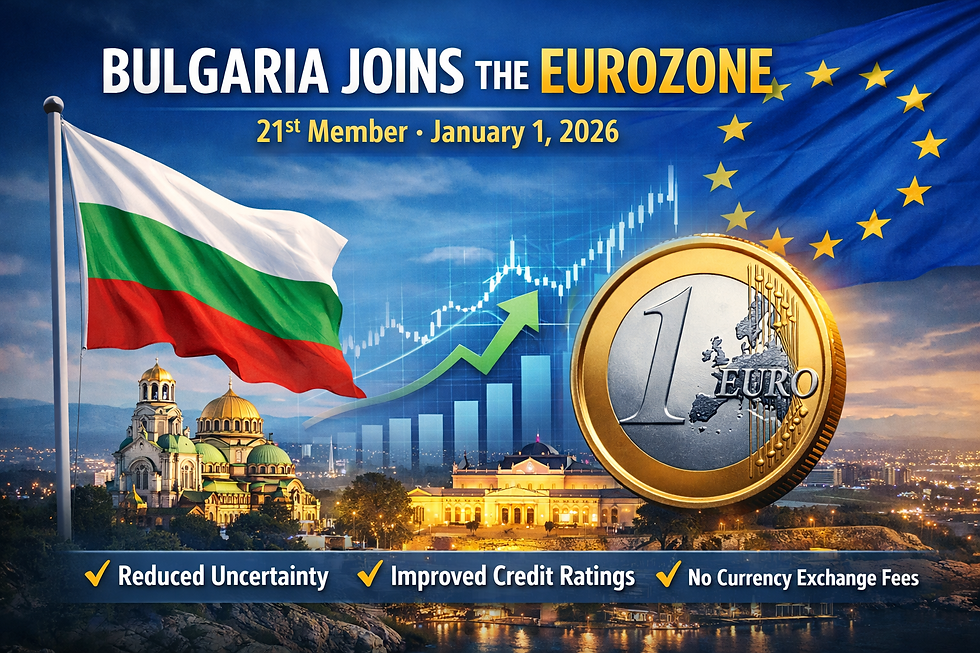
On 1 January 2026, Bulgaria officially adopted the euro and became the 21st member of the euro area — a milestone with real financial implications for households, businesses, and capital markets. Bulgaria in the Euro Area now directly translates into the economics of stability over uncertainty
This transition is more than symbolic. It reshapes how risk is priced, how capital flows, and how strategic decisions are made — reducing structural frictions that once limited Bulgaria’s financial integration.
Below are the key economic benefits flagged by European policymakers and institutions:
1. Reducing Uncertainty — Not Just a Political Slogan
Christine Lagarde, President of the European Central Bank, framed Bulgaria’s entry as an opportunity for “greater economic stability” and deeper integration with euro-area partners. Membership eliminates residual currency conversion risk that persisted even under a fixed peg prior to full euro adoption.
Removing this uncertainty matters for:
borrowing costs for governments and corporates
pricing of risk premia in financial instruments
investor confidence
cross-border planning and budgeting
Where once exporters and importers faced hidden friction from dual-currency expectations, they now operate with one clear monetary regime.
2. Expected Credit Rating Tailwinds
Although past fixed-peg regimes (like the lev-euro peg) provided nominal stability, full Eurozone membership strengthens Bangladesh’s integration into European institutional frameworks and monetary safety nets.
Following Bulgaria’s accession, markets and rating agencies often view Eurozone members as structurally more credible due to:
stronger institutional anchoring
access to ECB mechanisms
reduced external currency risk
Early indications from market commentary and credit agency reports suggest ratings outlooks are likely to improve or stabilise as a consequence. These dynamics are not immediate automatic upgrades, but a positive directional force on sovereign and corporate cost of capital.
3. Currency Friction Disappears — Even Beyond a Fixed Peg
Before 1 January 2026, the lev was pegged to the euro under ERM II with a fixed central rate of 1 EUR = 1.95583 BGN. But in practice, that peg still imposed real economic friction:
FX bid/ask spreads on cross-border transactions
Treasury and hedging costs for corporates
Settlement fees and administrative complexity
With full adoption, these micro-frictions vanish, creating:
smoother intra-Eurozone trade
lower transactional costs
clearer pricing signals for investors and treasury teams
For capital-intensive businesses operating on thin margins, that reduction in structural inefficiency is a consistent economic gain.
Institutional Endorsements: Credibility Backed by Leadership
While many statements during the accession process came from a range of actors, two consistent themes emerged:
Economic stability and integration matter for long-term growth (ECB messaging).
Euro adoption means security, predictability, and economic cohesion (European Parliament leadership).
Presidents and Commissioners have consistently framed euro accession as a step toward deeper structural resilience rather than a short-term political objective.
What This Means in Practical Terms
For corporate finance leaders, investors, and boards, Bulgaria’s euro
adoption should be evaluated as:
A reduction in structural risk + a narrowing of the cost of capital gap
These are not abstract concepts:
Lower risk premia improve valuation multiples
Greater price transparency enhances market efficiency
Institutional membership stabilises macro expectations
In strategic terms, Bulgaria’s euro accession doesn’t just change the unit of account — it changes the risk calculus for every financial decision made within the economy.
The Bottom Line: Bulgaria in the Euro Area Gets Us to The Economics of Stability over Uncertainty
Bulgaria now stands fully in the euro area. The core economic benefits reflect:
1. Reduced uncertainty and integrated monetary regime
2. Expected improvements in creditworthiness over time
3. Elimination of currency-related transaction friction
This shift strengthens both macro-financial stability and long-term opportunities for businesses, capital markets, and external investment.
And while adoption does not eliminate structural challenges, it creates a clearer economic environment upon which strategic decisions are now built — not guessed.

Comments